William Henry Fox Talbot (English, 1800-1877)
Oak tree in winter, Lacock Abbey, probably 1842-1843
Salt print from a calotype negative
19.3 x 16.5 cm, corners clipped
Made in the earliest days of photography, this salt print of a majestic oak, devoid of leaves on the grounds of Lacock Abbey, is the master of the landscape. Talbot was keenly aware of the value of timber on his estates, and the more lasting value of the place of grand trees in the landscape. In contrast to the other trees along the horizon line, here the inventor of photography emphasizes the oak’s size and structure silhouetted against the clear light of winter.
Inquire
Roger Fenton (English, 1819-1869)
"Afternoon," 1856
Salt print from a collodion negative
20.6 x 42.1 cm, top corners rounded, mounted on 47.4 x 63.0 cm paper
Fenton's clouds are the defining core of his extraordinary landscapes, in much the same way as those of Constable, who in a letter described the sky as both "the keynote" and "the chief organ of sentiment" in landscape painting, adding that "[the] landscape painter who does not make skies a very material part of his composition neglects to avail himself of one of his greatest aids. The sky is the source of light in nature and governs everything." Deeply inspired by Constable's cloud studies and Turner's explorations of atmosphere and light, Fenton's rendition of clouds and sky is an intensely felt meditation on nature which seems to hover between the visible and the imagined while manifesting a reverence for the observable world.
The preeminent British photographer of the 1850s, Fenton advocated the medium's place among the fine arts and mastered all its genres. This print is on par with the two celebrated Fenton cloud studies from the Rubel Collection, now at The Metropolitan Museum of Art and, like the other two, is unique.
Inquire
William Henry Fox Talbot (English, 1800-1877)
An aged red cedar tree in the grounds of Mt. Edgcumbe, early 1840s
Varnished salt print from a calotype negative
15.8 x 19.5 cm on 18.5 x 22.3 cm paper
This ancient cedar, tormented and mysterious, its head shrouded in darkness, its limbs and torso twisting in a swirl of activity, shows that Talbot was a keen observer of its visual characteristics, particularly how the constantly changing light modified its form.
In 1845 Talbot and Henneman travelled to Mount Edgcumbe (the seat of Talbot's relation, the Earl of Mount Edgcumbe) near Plymouth.
Inquire
John Payne Jennings (English, 1843-1926)
"Stybarrow Crag," The Lake District, 1870s
Albumen print
27.0 x 20.9 cm
Payne Jennings’s photographs are extremely rare compared with other successful British studios of the 1870s. The larger format of his photographs stood apart from contemporary studios that had moved away from expensive large prints towards smaller and more affordable whole-plate or even carte-de-visite views. His picturesque views were often included in special edition publications of British poets and novelists such as Wordsworth, Longfellow and Tennyson.
Inquire
Captain Horatio Ross (Scottish, 1801-1886)
Lone tree, Scottish coast, circa 1858
Albumen print from a waxed paper negative
26.1 x 33.4 cm
Angling his camera upwards, Ross silhouettes the tree against an empty sky, reducing its form to two-dimensional patterns emphasizing the intricate masses of tangled wood.
Inquire
John Dillwyn Llewelyn (Welsh, 1810-1882)
Lower Lake, Penllergare, South Wales, 1850s
Albumen print from a paper negative
16.8 x 21.0 cm, mounted on album page
Thereza Mary Dillwyn Llewelyn created this remarkable album for her personal collection. In doing so, she preserved the work of many gifted early British photographers in the Llewelyn Family Circle centered around their home at Penllergare in Swansea, Wales. With its rich subject matter, and a broad range of shared scientific interests it served as an important center for gathering photographs.
Thereza was the first child of John Dillwyn Llewelyn and Emma Thomasina née Talbot. Her father was one of Britain’s most accomplished landscape photographers. Her mother was William Henry Fox Talbot’s cousin. They corresponded regularly about photography. Later in life she recalled the enthusiasm her family and its circle had for photography, noting that “no one living at Penllergare could help being interested in what was of absorbing interest to my Father & Mother and I must have heard many conversations on the subject when letters to my Mother from her Cousin Henry Fox Talbot arrived…”
Her own work includes a wide range of portraits, landscapes and still lifes. These she carefully collated along with the work of her father, her husband Nevil Story-Maskelyne, William Henry Fox Talbot and other photographers connected to the family circle such as James Knight, and most notably Jane Martha St. John. She was the great aunt of the wife of John Dillwyn Llewelyn’s eldest son, and was also related to the Talbot family. “Aunt Jane” particularly enjoyed making photographic prints and is known to have printed from J.D. Llewelyn's negatives. The influence of this extended family's lifestyle and particularly that of their inter-personal relationships led to a unique and very special archive of early British photography preserved by Thereza Llewelyn.
Inquire
Hugh Owen (English, 1808-1897)
Queen Square, Bristol
Albumen print, 1860s-1870s, from a paper negative, before 1855
15.4 x 20.3 cm
Queen's Square, named after Queen Anne who visited Bristol in 1702, was the home of the city's merchant elite for much of the eighteenth and early 19th century. In 1831 a riot to protest local political opposition to the Reform Bill erupted and destroyed more than half of the buildings located on the North and West side of the square. Despite a rapid effort to rebuild, the area never again attained the same residential popularity. In the early 1860s it was proposed to turn the area into the location of Bristol's central railway station, a plan which ultimately did not come to fruition. Owen's decision to capture the square in this particular print may have been influenced by the specter of its possible demise.
Inquire
Sir John Frederick William Herschel (English, 1792-1872)
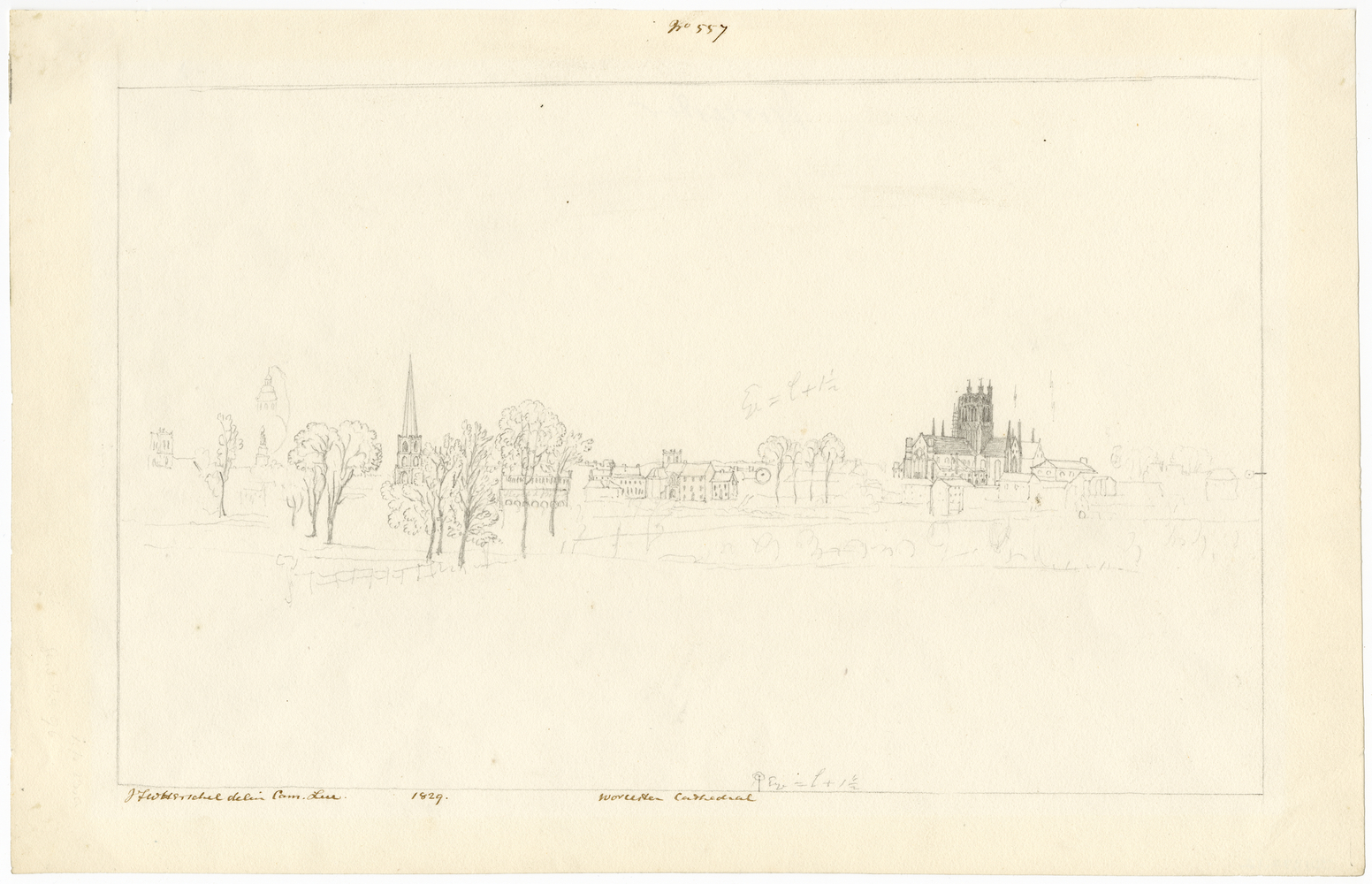
"Worcester Cathedral,” 1829
Camera lucida drawing, pencil on paper
20.2 x 32.2 cm on 24.4 x 38.5 cm paper
The great scientist Sir John Herschel proved himself gifted at drawing while still a schoolboy. The camera lucida raised his technical skills to new heights while his artistic talent translated them into precise and often beautiful drawings. While many artists of the time used the camera lucida, Herschel used it more successfully than his contemporaries. His camera lucida drawing of Worcester Cathedral is signed, titled, and dated by Herschel in ink. Situated on a bank overlooking the River Severn, Worcester Cathedral was built between 1084 and 1504 and is noteworthy for the many styles of English architecture in which it was constructed.
The overwhelming majority of Herschel's camera lucida drawings are now in public collections; only a few are known to remain in private collections.
Inquire
Roger Fenton (English, 1819-1869)
Landscape with waterfall, likely Braemar, River Dee, Scotland, 1850s
Salt print from a collodion negative
31.5 x 30.6 cm, top corners rounded
As a landscape photographer Fenton was without parallel among his contemporaries. His most compelling views of the English, Welsh and Scottish countrysides evoke the paintings of Constable and Turner and the Romantic poetry of William Wordsworth. A critic, for the Journal of the Photograhic Society in a review of the annual exhibition in 1858 noted of Fenton's work, "No one can touch Fenton for landscape....There is such an artistic feeling about the whole of these pictures...that they cannot fail to strike the beholder as something more than mere photographs."
Inquire
Benjamin Brecknell Turner (English, 1815-1894)
"In Loseley Park," 1852-1854
Albumen print from a waxed calotype negative
27.0 x 22.4 cm
Benjamin Brecknell Turner first took up photography in 1849. Like many of the early practitioners he was a “gentleman amateur” for whom photography was a passion, not a profession. In the early 1850s he photographed picturesque, quintessentially English scenes: ruined abbeys and castles, thatched barns and half-timbered houses, crumbling cottages, ancient oak trees and woodland paths, such as In Loseley Park. Turner’s poetic images reveal the beauty of vernacular subjects and the moral worth of tradition, nature, and rural life.
This print has been substantially cropped, presumably by the photographer, changing it from a horizontal to a vertical composition. Another print, in its horizontal format, 27 x 38.8 cm, is in the collection of the V&A, titled "Head of the Lake, Losely Park," Ph.41-1982. Turner titled each print separately.
Inquire
Frederick H. Evans (English, 1853-1943)
"Woodland Study, Redlands Woods" Surrey, 1893
Lantern slide
7.2 x 5.2 cm on 8.3 x 8.3 cm glass slide
Inquire
Frederick H. Evans (English, 1853-1943)
"Borrowdale," circa 1885
Platinum print
22.3 x 15.8 cm mounted on 35.0 x 25.4 cm paper. ruled in ink and wash
The Lake District in the north of England presents an area of concentrated beauty and variety which Evans found a “veritable paradise for photographers.” His physical health was invigorated by these stays in the country. Evans familiarized himself with every nuance of light and framing, the precise composition was everything. The photographic artist should “always use correct position… rather than changing perspective to suit the lens.” Evans also objected to the common practice of printing-in clouds from a separate negative, unwilling to compromise photographic truth.
As with many of Evans’s photographs, dating is extremely difficult. His initial visit to the Lake District was before he had his first camera. His next visit was certainly no later than 1883, by which time he had acquired his quarter-plate Sciopticon. He found his photographic style in subsequent visits, suggesting that his first successes in the area were around 1884 or 1885. Writing in 1905, Evans explained that his Lake District photographs were taken “some years back.” The period just before 1905 is unlikely, as he had just gotten married and was actively taking studio portraits to make a living. The 1890s present no opportunity for Lake District photography either as he was running a bookshop and was intensely engaged in photographing cathedral interiors.
Inquire
Captain Horatio Ross (Scottish, 1801-1886)
Sea coast near Netherley, Scotland, 1850s
Waxed paper negative
29.1 x 34.7 cm
Inquire
Captain Horatio Ross (Scottish, 1801-1886)
Sea coast near Netherley, Scotland, circa 1858
Albumen print from a waxed paper negative
24.5 x 33.4 cm
The landscape and architectural views of Horatio Ross (1901-1886), a Highland aristocrat and legendary marksman whose enthusiasm for photography was second only to his passion for nature, form a unique picture of life in mid-19th century Scotland. Ross was a founding member of the Photographic Society of Scotland in 1856 and one of its most vital supporters. His bold albumen print, with its paper negative, of a dramatic Scottish coastal view, circa 1858, attests to Ross’ technical skill and artistic originality.
Inquire
John Payne Jennings (English, 1843-1926)
"The Bowder Stone" Borrowdale, The Lake District, 1870s
Albumen print
24.0 x 29.3 cm
The photographs of John Payne Jennings (1843-1926) are extremely rare compared with those from other successful British studios of the 1870s. Jennings’s picturesque views were often included in special edition publications of British poets and novelists. This albumen print made in the 1870s from his English Lake District portfolio depicts the sometimes dramatic landscape that inspired the Romantic poet William Wordsworth and was adored by John Ruskin, who owned a home nearby on the shore of Coniston Water.
Inquire
Henry White (English, 1819-1903)
"The Cornfield" Surrey, from "Photographic Art Treasures" Part V, Published July 1857
Photogalvanograph proof on chine collé
17.5 x 24.6 cm on 23.1 x 28.3 cm paper
In the 1850s London lawyer Henry White practiced photography with uncommon skill and was recognized as one of Britain's most gifted landscape photographers. Like Roger Fenton, he possessed a technical ability that enabled him to perceive and render a scene as monochromatic shifts of the subtlest distinction. As with many of his photographs, this print registers a city-dweller's delight in natural surroundings, here finding a farmer napping in one of the stooks.
Photogalvanograph
Paul Pretsch (1808-1873) began his career under Alois Auer in the Vienna Staatsdruckerei, before moving to London. In 1854 this Viennese resident in London patented a process called ‘photo-galvanography’ for the printed reproduction of photographs. His Photo-Galvano-Graphic Company launched the first commercial attempt to print photographs. It was the beginning of a new era in the history of photography and printing: photo-engraving, the publication of photographs in printing ink, the first relief half-tone and the first commercial use of half-tone.
One of the first professionals to embrace Pretsch’s work was Roger Fenton (1819-1869), at the height of his fame from Crimea and Royal commissions. In 1856 and 1857 the book Photographic Art Treasures was planned as a series of monthly editions of photogalvanograph prints to enable ordinary people to have reproductions of great works. Fenton provided the bulk of prints, but other notable photographers included Joseph Cundall (1818-1895) and Robert Howlett (1831-1858), William Henry Lake Price (1810-1896), Oscar Gustave Rejlander (1813-1875), and Henry White.
Inquire
William Henry Fox Talbot (English, 1800-1877)
Oak tree in winter, Lacock Abbey, probably 1842-1843
Salt print from a calotype negative
19.3 x 16.5 cm, corners clipped
Made in the earliest days of photography, this salt print of a majestic oak, devoid of leaves on the grounds of Lacock Abbey, is the master of the landscape. Talbot was keenly aware of the value of timber on his estates, and the more lasting value of the place of grand trees in the landscape. In contrast to the other trees along the horizon line, here the inventor of photography emphasizes the oak’s size and structure silhouetted against the clear light of winter.
Roger Fenton (English, 1819-1869)
"Afternoon," 1856
Salt print from a collodion negative
20.6 x 42.1 cm, top corners rounded, mounted on 47.4 x 63.0 cm paper
Fenton's clouds are the defining core of his extraordinary landscapes, in much the same way as those of Constable, who in a letter described the sky as both "the keynote" and "the chief organ of sentiment" in landscape painting, adding that "[the] landscape painter who does not make skies a very material part of his composition neglects to avail himself of one of his greatest aids. The sky is the source of light in nature and governs everything." Deeply inspired by Constable's cloud studies and Turner's explorations of atmosphere and light, Fenton's rendition of clouds and sky is an intensely felt meditation on nature which seems to hover between the visible and the imagined while manifesting a reverence for the observable world.
The preeminent British photographer of the 1850s, Fenton advocated the medium's place among the fine arts and mastered all its genres. This print is on par with the two celebrated Fenton cloud studies from the Rubel Collection, now at The Metropolitan Museum of Art and, like the other two, is unique.
William Henry Fox Talbot (English, 1800-1877)
An aged red cedar tree in the grounds of Mt. Edgcumbe, early 1840s
Varnished salt print from a calotype negative
15.8 x 19.5 cm on 18.5 x 22.3 cm paper
This ancient cedar, tormented and mysterious, its head shrouded in darkness, its limbs and torso twisting in a swirl of activity, shows that Talbot was a keen observer of its visual characteristics, particularly how the constantly changing light modified its form.
In 1845 Talbot and Henneman travelled to Mount Edgcumbe (the seat of Talbot's relation, the Earl of Mount Edgcumbe) near Plymouth.
John Payne Jennings (English, 1843-1926)
"Stybarrow Crag," The Lake District, 1870s
Albumen print
27.0 x 20.9 cm
Payne Jennings’s photographs are extremely rare compared with other successful British studios of the 1870s. The larger format of his photographs stood apart from contemporary studios that had moved away from expensive large prints towards smaller and more affordable whole-plate or even carte-de-visite views. His picturesque views were often included in special edition publications of British poets and novelists such as Wordsworth, Longfellow and Tennyson.
Captain Horatio Ross (Scottish, 1801-1886)
Lone tree, Scottish coast, circa 1858
Albumen print from a waxed paper negative
26.1 x 33.4 cm
Angling his camera upwards, Ross silhouettes the tree against an empty sky, reducing its form to two-dimensional patterns emphasizing the intricate masses of tangled wood.
John Dillwyn Llewelyn (Welsh, 1810-1882)
Lower Lake, Penllergare, South Wales, 1850s
Albumen print from a paper negative
16.8 x 21.0 cm, mounted on album page
Thereza Mary Dillwyn Llewelyn created this remarkable album for her personal collection. In doing so, she preserved the work of many gifted early British photographers in the Llewelyn Family Circle centered around their home at Penllergare in Swansea, Wales. With its rich subject matter, and a broad range of shared scientific interests it served as an important center for gathering photographs.
Thereza was the first child of John Dillwyn Llewelyn and Emma Thomasina née Talbot. Her father was one of Britain’s most accomplished landscape photographers. Her mother was William Henry Fox Talbot’s cousin. They corresponded regularly about photography. Later in life she recalled the enthusiasm her family and its circle had for photography, noting that “no one living at Penllergare could help being interested in what was of absorbing interest to my Father & Mother and I must have heard many conversations on the subject when letters to my Mother from her Cousin Henry Fox Talbot arrived…”
Her own work includes a wide range of portraits, landscapes and still lifes. These she carefully collated along with the work of her father, her husband Nevil Story-Maskelyne, William Henry Fox Talbot and other photographers connected to the family circle such as James Knight, and most notably Jane Martha St. John. She was the great aunt of the wife of John Dillwyn Llewelyn’s eldest son, and was also related to the Talbot family. “Aunt Jane” particularly enjoyed making photographic prints and is known to have printed from J.D. Llewelyn's negatives. The influence of this extended family's lifestyle and particularly that of their inter-personal relationships led to a unique and very special archive of early British photography preserved by Thereza Llewelyn.
Hugh Owen (English, 1808-1897)
Queen Square, Bristol
Albumen print, 1860s-1870s, from a paper negative, before 1855
15.4 x 20.3 cm
Queen's Square, named after Queen Anne who visited Bristol in 1702, was the home of the city's merchant elite for much of the eighteenth and early 19th century. In 1831 a riot to protest local political opposition to the Reform Bill erupted and destroyed more than half of the buildings located on the North and West side of the square. Despite a rapid effort to rebuild, the area never again attained the same residential popularity. In the early 1860s it was proposed to turn the area into the location of Bristol's central railway station, a plan which ultimately did not come to fruition. Owen's decision to capture the square in this particular print may have been influenced by the specter of its possible demise.
Sir John Frederick William Herschel (English, 1792-1872)
"Worcester Cathedral,” 1829
Camera lucida drawing, pencil on paper
20.2 x 32.2 cm on 24.4 x 38.5 cm paper
The great scientist Sir John Herschel proved himself gifted at drawing while still a schoolboy. The camera lucida raised his technical skills to new heights while his artistic talent translated them into precise and often beautiful drawings. While many artists of the time used the camera lucida, Herschel used it more successfully than his contemporaries. His camera lucida drawing of Worcester Cathedral is signed, titled, and dated by Herschel in ink. Situated on a bank overlooking the River Severn, Worcester Cathedral was built between 1084 and 1504 and is noteworthy for the many styles of English architecture in which it was constructed.
The overwhelming majority of Herschel's camera lucida drawings are now in public collections; only a few are known to remain in private collections.
Roger Fenton (English, 1819-1869)
Landscape with waterfall, likely Braemar, River Dee, Scotland, 1850s
Salt print from a collodion negative
31.5 x 30.6 cm, top corners rounded
As a landscape photographer Fenton was without parallel among his contemporaries. His most compelling views of the English, Welsh and Scottish countrysides evoke the paintings of Constable and Turner and the Romantic poetry of William Wordsworth. A critic, for the Journal of the Photograhic Society in a review of the annual exhibition in 1858 noted of Fenton's work, "No one can touch Fenton for landscape....There is such an artistic feeling about the whole of these pictures...that they cannot fail to strike the beholder as something more than mere photographs."
Benjamin Brecknell Turner (English, 1815-1894)
"In Loseley Park," 1852-1854
Albumen print from a waxed calotype negative
27.0 x 22.4 cm
Benjamin Brecknell Turner first took up photography in 1849. Like many of the early practitioners he was a “gentleman amateur” for whom photography was a passion, not a profession. In the early 1850s he photographed picturesque, quintessentially English scenes: ruined abbeys and castles, thatched barns and half-timbered houses, crumbling cottages, ancient oak trees and woodland paths, such as In Loseley Park. Turner’s poetic images reveal the beauty of vernacular subjects and the moral worth of tradition, nature, and rural life.
This print has been substantially cropped, presumably by the photographer, changing it from a horizontal to a vertical composition. Another print, in its horizontal format, 27 x 38.8 cm, is in the collection of the V&A, titled "Head of the Lake, Losely Park," Ph.41-1982. Turner titled each print separately.
Frederick H. Evans (English, 1853-1943)
"Woodland Study, Redlands Woods" Surrey, 1893
Lantern slide
7.2 x 5.2 cm on 8.3 x 8.3 cm glass slide
Frederick H. Evans (English, 1853-1943)
"Borrowdale," circa 1885
Platinum print
22.3 x 15.8 cm mounted on 35.0 x 25.4 cm paper. ruled in ink and wash
The Lake District in the north of England presents an area of concentrated beauty and variety which Evans found a “veritable paradise for photographers.” His physical health was invigorated by these stays in the country. Evans familiarized himself with every nuance of light and framing, the precise composition was everything. The photographic artist should “always use correct position… rather than changing perspective to suit the lens.” Evans also objected to the common practice of printing-in clouds from a separate negative, unwilling to compromise photographic truth.
As with many of Evans’s photographs, dating is extremely difficult. His initial visit to the Lake District was before he had his first camera. His next visit was certainly no later than 1883, by which time he had acquired his quarter-plate Sciopticon. He found his photographic style in subsequent visits, suggesting that his first successes in the area were around 1884 or 1885. Writing in 1905, Evans explained that his Lake District photographs were taken “some years back.” The period just before 1905 is unlikely, as he had just gotten married and was actively taking studio portraits to make a living. The 1890s present no opportunity for Lake District photography either as he was running a bookshop and was intensely engaged in photographing cathedral interiors.
Captain Horatio Ross (Scottish, 1801-1886)
Sea coast near Netherley, Scotland, 1850s
Waxed paper negative
29.1 x 34.7 cm
Captain Horatio Ross (Scottish, 1801-1886)
Sea coast near Netherley, Scotland, circa 1858
Albumen print from a waxed paper negative
24.5 x 33.4 cm
The landscape and architectural views of Horatio Ross (1901-1886), a Highland aristocrat and legendary marksman whose enthusiasm for photography was second only to his passion for nature, form a unique picture of life in mid-19th century Scotland. Ross was a founding member of the Photographic Society of Scotland in 1856 and one of its most vital supporters. His bold albumen print, with its paper negative, of a dramatic Scottish coastal view, circa 1858, attests to Ross’ technical skill and artistic originality.
John Payne Jennings (English, 1843-1926)
"The Bowder Stone" Borrowdale, The Lake District, 1870s
Albumen print
24.0 x 29.3 cm
The photographs of John Payne Jennings (1843-1926) are extremely rare compared with those from other successful British studios of the 1870s. Jennings’s picturesque views were often included in special edition publications of British poets and novelists. This albumen print made in the 1870s from his English Lake District portfolio depicts the sometimes dramatic landscape that inspired the Romantic poet William Wordsworth and was adored by John Ruskin, who owned a home nearby on the shore of Coniston Water.
Henry White (English, 1819-1903)
"The Cornfield" Surrey, from "Photographic Art Treasures" Part V, Published July 1857
Photogalvanograph proof on chine collé
17.5 x 24.6 cm on 23.1 x 28.3 cm paper
In the 1850s London lawyer Henry White practiced photography with uncommon skill and was recognized as one of Britain's most gifted landscape photographers. Like Roger Fenton, he possessed a technical ability that enabled him to perceive and render a scene as monochromatic shifts of the subtlest distinction. As with many of his photographs, this print registers a city-dweller's delight in natural surroundings, here finding a farmer napping in one of the stooks.
Photogalvanograph
Paul Pretsch (1808-1873) began his career under Alois Auer in the Vienna Staatsdruckerei, before moving to London. In 1854 this Viennese resident in London patented a process called ‘photo-galvanography’ for the printed reproduction of photographs. His Photo-Galvano-Graphic Company launched the first commercial attempt to print photographs. It was the beginning of a new era in the history of photography and printing: photo-engraving, the publication of photographs in printing ink, the first relief half-tone and the first commercial use of half-tone.
One of the first professionals to embrace Pretsch’s work was Roger Fenton (1819-1869), at the height of his fame from Crimea and Royal commissions. In 1856 and 1857 the book Photographic Art Treasures was planned as a series of monthly editions of photogalvanograph prints to enable ordinary people to have reproductions of great works. Fenton provided the bulk of prints, but other notable photographers included Joseph Cundall (1818-1895) and Robert Howlett (1831-1858), William Henry Lake Price (1810-1896), Oscar Gustave Rejlander (1813-1875), and Henry White.
